Everything you need to know about what makes each hero unique: Factions, Affinities, Archetypes, Alignment, Rarity, Abilities, and Leader Bonuses.
Introduction
Every hero in Godforge is defined by a set of characteristics that determine who they are, how they fight, and where they fit on your team. If you’ve read the Getting Started guide, you’ve already seen a brief overview of these concepts. This guide goes deeper into each one so you can make informed decisions about which heroes to invest in, how to build around them, and why certain combinations work better than others.
There are seven key characteristics that define a hero: Faction, Affinity, Archetype, Alignment, Rarity, Abilities, and Leader Bonus. Let’s break them all down.
Factions (Realms)
Every hero belongs to one of nine Factions, each rooted in a real-world mythology. Factions are sometimes referred to as “Realms” and you’ll see both terms used interchangeably in the community and on this site.
The Nine Factions

Aaru – Inspired by Egyptian mythology. Heroes from Aaru draw on the power of the pharaohs, the gods of the Nile, and the mysteries of the afterlife. Notable heroes include Anubis (a Legendary Disruptor known for Despair and Divinity control), Ra (a Legendary Invoker with Blaze synergy), Isis (an Epic Invoker with healing and revival), and Ramses (a Rare Slayer and one of the three starter heroes, specializing in Acid debuffs).

Asgard – Inspired by Norse mythology. The heroes of Asgard channel the frost, thunder, and fate of the Viking sagas. Notable heroes include Odin (a Legendary Disruptor whose Ragnarok ultimate shreds enemy Divinity), Thor (a Legendary Brawler), Loki (a Legendary Disruptor and master of mischief), Brynhild (an Epic Defender with Radiance, Defense Up, Attack Down, and Blaze with one of the strongest mitigation kits in the game), and Skadi (a Rare Disruptor with Freeze and speed manipulation).

Avalon – Inspired by Arthurian legend. Knights, sorcerers, and mythical beasts of the Round Table make up this faction. Notable heroes include King Arthur (an Epic Brawler), Mordred (an Epic Disruptor specializing in Confuse and Corrupt), Viviane (the Lady of the Lake), and the Green Knight (an Epic Defender with Taunt, Counterattack, and Drain).

Ekur – Inspired by Mesopotamian mythology. Ancient Sumerian and Babylonian gods and legends form this faction. Notable heroes include Shamash (a Legendary Invoker with reviving, healing, barrier-granting, and one of the most complete support kits in the game), Gilgamesh (an Epic Brawler whose damage scales inversely with his HP), and Nanaya.

Izumo – Inspired by Japanese mythology. Samurai, spirits, and deities of the Japanese pantheon. Notable heroes include Amaterasu (a Legendary Invoker), Izanagi, Ryujin, and Oda Nobunaga. Izumo’s faction weapon is notable for its Temporal Aegis and Arcane Aegis mechanics that trigger when turn meter or divinity is reduced.

Olympus – Inspired by Greek mythology. The gods of Mount Olympus bring thunder, wisdom, and raw power. Notable heroes include Zeus (a Legendary Slayer, was widely considered one of the strongest heroes for AoE damage and clearing enemy waves in Alpha), Hercules (a Legendary Brawler with a near-unkillable kit including built-in death prevention), Athena (a Legendary Defender), Leonidas (an Epic Defender with AoE Attack Down and Defense Down), and Pandora (an Epic Disruptor with buff stealing and random disables).

Omeyocan – Inspired by Aztec and Mayan mythology. Sun gods, jaguars, and feathered serpents power this faction. Notable heroes include Quetzalcoatl (a Legendary Invoker with a powerful Speed aura, team speed/accuracy/attack buffs, healing, turn meter boosts, and a double revive passive and one of the best overall support heroes), Xolotl, Ixchel, and Lady Xoc (a Rare Slayer and another starter hero, specializing in Bleed debuffs).

Tian – Inspired by Chinese mythology. Heroes from Tian draw on the legends of imperial China, the Jade Emperor’s court, and the monkey king’s adventures. Notable heroes include Sun Wukong (a Legendary Brawler), Guan Yu (a Rare Slayer and the third starter hero, specializing in Drain debuffs), Mulan, and Pangu (valued for Initiative Down and boss control).

Vyraj – Inspired by Slavic mythology. Dark forests, ancient spirits, and Eastern European folklore define this faction. Notable heroes include Baba Yaga, Veles, Perun (a Legendary Brawler), and Dracula (an Epic Slayer focused on Bleed stacking and buff removal).
Why Factions Matter
Factions affect gameplay in several ways. Each faction has its own unique weapon (crafted at the Forge of Wayland) with a faction-specific passive bonus, and heroes who equip a weapon matching their faction receive an Attunement Bonus on top of the weapon’s base stats. The Early Access Campaign is structured around faction-based levels, with each faction’s mythology driving its own storyline and encounters. Various game modes may require or reward using heroes from specific factions, so building a diverse roster across factions helps you complete objectives and access more content. Future updates are expected to expand faction-based events, restrictions, and bonuses similar to Faction Wars in other hero collector games. On your hero’s card and in-game portrait, each faction is represented by a unique Realm Flag icon so you can quickly identify a hero’s origin.
→ Explore all heroes by faction: Heroes Database | Browse Realms: Realms
Affinities
Affinity is the elemental rock-paper-scissors system in Godforge. Every hero has one of four affinities, and matchups in battle are directly affected by which affinity your heroes have relative to the enemies they’re fighting.
The Affinity Triangle
The three main affinities form a triangle of advantage:
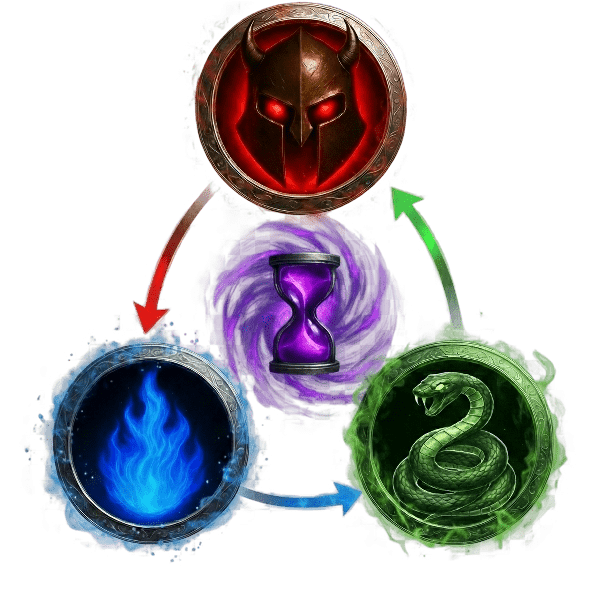
- Strength (Red) beats Wisdom (Blue)
- Wisdom (Blue) beats Cunning (Green)
- Cunning (Green) beats Strength (Red)
The fourth affinity, Eternal (Purple), sits in the middle of the triangle. Eternal heroes have no disadvantage against any affinity, and they receive a small advantage against all enemies (10% Strong Hit chance). They can never suffer a Weak Hit.
How Affinity Affects Combat
When you attack an enemy where you have affinity advantage, there is a 30% chance for a Strong Hit. A Strong Hit increases your damage by 30%.
When you attack an enemy where you have affinity disadvantage, there is a 30% chance for a Weak Hit. A Weak Hit reduces your damage by 30%, prevents critical hits, and prevents you from placing any negative effects (debuffs or disables) on the target. That last part is critical, if your Disruptor is trying to land Confuse or Stun on an enemy they’re weak against, there’s a real chance it simply won’t work, not because of Resistance, but because of a Weak Hit.
When there’s no advantage or disadvantage (same affinity vs. same affinity, or non-Eternal vs. non-Eternal without a triangle relationship), neither Strong Hits nor Weak Hits occur from affinity.
Affinity Color Coding
Affinities are color-coded throughout the game and on this site:
| Affinity | Color | Icon |
|---|---|---|
| Strength | Red |  |
| Wisdom | Blue |  |
| Cunning | Green |  |
| Eternal | Purple |  |
Building Around Affinity
The simplest takeaway: bring a mixed-affinity team. If you stack three Strength heroes and run into a stage full of Cunning enemies, you’re in trouble. Having at least two different affinities (ideally three, or including an Eternal hero) gives you flexibility to handle whatever the enemy throws at you.
When pushing specific content where you know the enemy affinity, you can tilt your team toward advantage. For example, if a campaign stage or dungeon is full of Wisdom enemies, bringing extra Strength heroes gives you 30% Strong Hit chances across the board.
Eternal heroes are valuable precisely because they never suffer Weak Hits. They’re safe picks when you’re unsure what you’ll face, and they pair well with any team composition.
→ Filter heroes by affinity: Heroes Database
Archetypes (Hero Roles)
Archetypes define a hero’s combat role – what they’re designed to do on your team, which stats they prioritize, and what type of gear they attune to. There are five archetypes in Godforge.
Defender – The Tank
Defenders specialize in protecting the team. Their kits revolve around shields, damage mitigation, intercepts, taunts, and ally protection. They have high base HP and Defense but low damage output. Defenders are the first into the fight and the last to fall.
Primary Stats: HP, Defense
Gear Attunement: Plate Mail – each attuned piece reduces incoming damage from hits by 1% Common Buffs/Effects: Shield, Protect, Intercept, Defense Up, Radiance
When to use them: Any time you need survivability. Essential for boss fights, difficult Tower of Strife stages, and content where your team is getting killed before they can act.
Example Heroes: Athena (Legendary, Olympus), Brynhild (Epic, Asgard), Green Knight (Epic, Avalon), Leonidas (Epic, Olympus), Hound of Duat (Epic, Aaru)
Invoker – The Support/Healer
Invokers are the backbone of any team’s sustainability. They heal, buff, manipulate turn meter, and empower allies rather than dealing damage directly. They have high base Speed and Initiative but low durability compared to Defenders.
Primary Stats: Speed, Initiative, Resistance
Gear Attunement: Cloth – each attuned piece provides a 1% bonus to outgoing healing and turn meter boosts
Common Buffs/Effects: Mend, Attack Up, Speed Up, Radiance, Turn Meter manipulation, Divinity support
When to use them: Almost always. Most teams want at least one Invoker. They keep your team alive, speed up your turn order, and get your ultimates online faster.
Example Heroes: Shamash (Legendary, Ekur), Quetzalcoatl (Legendary, Omeyocan), Amaterasu (Legendary, Izumo), Imhotep (Epic, Aaru), Isis (Epic, Aaru)
Brawler – The Bruiser
Brawlers are self-sustaining fighters who trade health for power. They sit between Defenders and Slayers – durable enough to survive extended fights, with enough damage to be threatening. Many Brawler abilities scale from both HP and Attack, and their kits often include self-healing, self-buffing, and mechanics that reward them for taking damage.
Primary Stats: HP, Attack (often both)
Gear Attunement: Chain Mail – each attuned piece provides a 0.5% bonus to all stats Common Buffs/Effects: Self-healing, Barrier (self), Retaliate, HP-scaling damage
When to use them: When you need a damage dealer who can survive without babysitting. Great as frontline damage in content where Slayers would die too quickly, and strong against bosses thanks to HP-scaling mechanics.
Example Heroes: Hercules (Legendary, Olympus), Perun (Legendary, Vyraj), Sun Wukong (Legendary, Tian), Gilgamesh (Epic, Ekur), Beowulf (Epic, Asgard)
Disruptor – The Controller
Disruptors manipulate the battlefield through debuffs, disables, and turn/Divinity manipulation. They don’t hit the hardest, but they control the flow of combat – preventing enemies from acting, stripping their buffs, or reducing their effectiveness. They have high base Speed and Initiative, making them ideal for going first and shutting down threats before they act.
Primary Stats: Speed, Initiative, Accuracy
Gear Attunement: Nightweave – each attuned piece provides a 1% bonus to ignoring enemy Resistance
Common Debuffs/Disables: Confuse, Freeze, Stun, Sleep, Attack Down, Defense Down, Speed Down, Despair, Turn Meter reduction, Divinity manipulation
When to use them: Whenever enemy actions are dangerous. Disruptors shine in wave-based content (locking enemies down before they can attack) and in PvP Arena (going first and disabling the enemy team). Also critical for boss mechanics that require debuff or Divinity control.
Example Heroes: Odin (Legendary, Asgard), Anubis (Legendary, Aaru), Loki (Legendary, Asgard), Mordred (Epic, Avalon), Pandora (Epic, Olympus), Skadi (Rare, Asgard)
Slayer – The DPS
Slayers are pure offense. They have the highest Attack stats in the game but the lowest survivability. Their job is to kill enemies as quickly as possible, and they need the rest of the team to keep them alive while they do it. Some Slayers deal raw direct damage, while others rely on stacking debuffs (Bleed, Blaze, Acid) for sustained damage.
Primary Stats: Attack, Crit Rate, Crit Damage
Gear Attunement: Leather – each attuned piece provides a 1% damage bonus
Common Abilities: High-multiplier single-target and AoE attacks, debuff-enhanced damage, buff removal
When to use them: When you need things dead fast. Slayers are your primary damage source for clearing waves and nuking bosses. Just make sure you have a Defender or Invoker keeping them alive.
Example Heroes: Zeus (Legendary, Olympus), Dracula (Epic, Vyraj), Bastet (Epic, Aaru), Lady Xoc (Rare, Omeyocan), Ramses (Rare, Aaru), Guan Yu (Rare, Tian)
Archetype Attunement Summary
| Archetype | Gear Type | Attunement Bonus (per piece) |
|---|---|---|
| Defender | Plate Mail | 1% reduced incoming damage |
| Invoker | Cloth | 1% healing and TM boost bonus |
| Brawler | Chain Mail | 0.5% bonus to all stats |
| Disruptor | Nightweave | 1% ignore Resistance |
| Slayer | Leather | 1% damage bonus |
Note: Attunement was not active during alpha testing but is confirmed as a core progression mechanic. When live, equipping six pieces of the correct gear type on a hero will provide a meaningful stacking bonus on top of your gear stats. Check current patch notes for attunement availability in Early Access.
Team Composition Basics
A well-rounded team typically includes a mix of archetypes. A common starting framework is one Defender or Brawler to absorb damage, one Invoker to heal and buff, and two to three damage dealers and/or controllers (Slayers, Disruptors, or a second Brawler). The exact mix depends on the content and boss fights might demand more control and survivability, while wave-clearing stages reward raw damage and speed.
Archetype diversity can also have mechanical benefits. During alpha testing, the boss Fafnir’s Blaze placement chance was reduced by 25% for each unique archetype on the team, meaning a five-archetype squad significantly weakened one of his most dangerous mechanics. Expect similar systems in Early Access where bringing diverse archetypes is mechanically rewarded.
→ Filter heroes by archetype: Heroes Database
Alignment (Order vs. Chaos)
Every hero is aligned with either Order or Chaos.
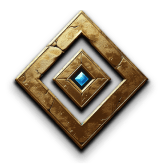
Order is represented by a diamond icon with concentric diamonds inside. Order-aligned heroes are thematically associated with stability, protection, and structure. Order is the pattern superimposed on chaos that unifies the living world into a place where all beings can live and thrive.
Think Odin upholding the cosmic order, or Athena defending the righteous.
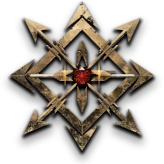
Chaos is represented by a star or compass rose icon. Eight arrows pointing outwards at cardinal directions. Chaos is the primordial ooze with which the metaverse was shaped.
Chaos-aligned heroes are thematically tied to disruption, trickery, and aggression. Think Loki’s mischief, or Set’s rebellion against the gods.
How Alignment Affects Gameplay
During alpha testing the Caverns of Chaos, Alignment was primarily relevant for certain challenge objectives (e.g., “defeat 5 Order-aligned enemies” or “use 3 Chaos heroes”). Some hero abilities also interact with Alignment – for example, Percival deals bonus damage to Chaos enemies, and Anubis gains double Divinity when an Order enemy dies. The Early Access Tower of Strife features Order/Chaos rotations, suggesting Alignment will play a more active role in team selection going forward.
One of the game play modes, Tower of Strife, makes players choose Order vs Chaos to determine encounters, and prizes for completing them.
Alignment is expected to grow in importance with future game modes, potentially including Alignment-specific content, event modifiers, and narrative elements. For now, it’s worth knowing your heroes’ Alignments so you can meet specific requirements, but it’s not a primary team-building consideration.
→ Filter heroes by alignment: Heroes Database
Rarity
Heroes come in five rarity tiers that determine their base star level, stat ceilings, and kit complexity:
| Rarity | Base Stars | Description |
|---|---|---|
| Common | 1-star | Simple kits, lowest base stats. Useful as early-game filler and may be needed for specific content restrictions. |
| Uncommon | 2-star | Slightly more capable. Some content may force you to use Uncommon heroes, so keep at least one leveled. (In alpha, certain Cavern floors had rarity restrictions.) |
| Rare | 3-star | The backbone of many rosters. Rares have passives (at 3-star Ascension), meaningful ability kits, and many perform surprisingly well even in mid-to-late game. The three starter heroes (Ramses, Lady Xoc, Guan Yu) are all Rares. |
| Epic | 4-star | Strong kits with deeper mechanics, more impactful awakenings, and higher stat ceilings. Many Epics are core to endgame teams. |
| Legendary | 5-star | The most powerful heroes in the game. Complex kits, high stats, and often game-defining mechanics. Harder to obtain and harder to awaken (requires Legendary duplicates or imprints). |
Don’t Sleep on Lower Rarities
One of Godforge’s design strengths is that lower-rarity heroes have genuine value. Rares like Skadi, Isolde, and the three starter heroes proved during alpha testing that they can carry deep into progression. Some lower-rarity heroes also have incredible passives that make them top-tier Imprint candidates even after you’ve outgrown them as combat units (Isolde’s “heal allies when a Defender is attacked” passive is a prime example).
Common and Uncommon heroes may be required for specific content restrictions or challenges, and they can be recycled (unbound) for Spirits once you’ve moved past them.
Base Stats
Every hero has a set of base stats that define their raw power and role on the battlefield. These stats grow as you level a hero (up to level 60) and are further increased through promotion, ascension, and gear. Understanding what each stat does and which stats matter most for a given hero is key to building effective teams.
If you have played other RPG style games most of these will likely familiar.
The Nine Stats
- HP (Health Points) – The hero’s total health pool. When HP reaches zero, the hero is defeated. Defenders and Brawlers tend to have the highest base HP, making them your frontline survivors.
- ATK (Attack) – Determines the damage dealt by most offensive abilities. Slayers typically have the highest base Attack, but any hero with damage-dealing skills benefits from it. Some abilities scale from other stats like DEF or HP instead – check the skill description.
- DEF (Defense) – Reduces incoming damage from all hits. Higher Defense means each attack hurts less. Defenders naturally have high base Defense, but stacking it on any hero improves their survivability.
- SPD (Speed) – Controls how quickly a hero’s Turn Meter fills. Faster heroes take more frequent turns, meaning more abilities used over the course of a fight. Speed is arguably the most universally important stat. A hero that never gets a turn can’t do anything, no matter how strong their kit is.
- INIT (Initiative) – Accelerates Divinity generation, which fuels ultimate abilities. Think of Initiative as “Speed for your ultimate” – while Speed determines how often you take turns, Initiative determines how quickly you reach your game-changing ultimate. Heroes with high Initiative can fire off ultimates earlier and more frequently, which can swing entire fights.
- CRATE (Crit Rate) – The percentage chance of landing a critical hit, which deals bonus damage. Crit Rate caps at 100%. Slayers and other damage-focused heroes benefit most from stacking Crit Rate, but it’s only effective when paired with Crit Damage.
- CDMG (Crit Damage) – Increases the bonus damage multiplier applied when a critical hit lands. High Crit Damage without Crit Rate is wasted potential, and vice versa. These two stats scale together and should be built in tandem.
- ACC (Accuracy) – Increases the chance of landing debuffs, disables, and other negative effects on enemies. Without enough Accuracy, your Disruptors and debuff-reliant heroes will have their effects resisted even when they land a hit. How much Accuracy you need scales with the content you’re tackling harder content demands more.
- RES (Resistance) – The defensive counterpart to Accuracy. Higher Resistance reduces the chance of enemy debuffs and disables sticking to your hero. Resistance also has a unique secondary function in Godforge: it reduces damage taken from critical hits, making it a sneaky-strong defensive stat that’s easy to undervalue.
How Stats Grow
A hero’s base stats increase primarily through leveling (up to level 60) and promotion (increasing star rank by sacrificing other heroes or Spirits). Ascension provides additional stat boosts at each ascension star, and gear is where the real customization happens. Each of the six armor slots can roll main stats and substats that further shape a hero’s strengths.
Different gear slots can roll different main stats. For example, Helmets can roll Resistance, Accuracy, Initiative, or Crit Rate as their main stat, while Chest Pieces offer Resistance, HP%, DEF%, or ATK%. This slot-specific stat availability is important to understand when farming gear for specific builds. But more on this in another guide.
General Stat Priorities by Archetype
Not every stat matters equally for every hero. Here’s a general guideline for which stats to prioritize based on archetype:
| Archetype | Primary Stats | Secondary Stats | Notes |
|---|---|---|---|
| Defender | HP, DEF, SPD | RES, ACC | Survivability first. Speed ensures they can apply Protect/Intercept before allies take hits. |
| Invoker | SPD, HP, RES | INIT, ACC | Supports need to act first. Resistance keeps them from being disabled. Initiative fuels early ultimates. |
| Brawler | HP, ATK, DEF | SPD, CRATE, CDMG | Bruisers that need to survive and deal damage. Some scale from HP or DEF, so check ability descriptions. |
| Disruptor | SPD, ACC, HP | INIT, RES | Accuracy is critical. Resisted debuffs are wasted turns. Speed and Initiative let them control the fight early. |
| Slayer | ATK, CRATE, CDMG | SPD, ACC | Pure damage. Stack offensive stats aggressively, but don’t neglect Speed entirely or they’ll never get a turn. |
These are starting guidelines, not rigid rules. As you progress and encounter specific content challenges, you’ll learn when to deviate and sometimes your Slayer needs Accuracy to land a key debuff, or your Defender needs Initiative to rush an ultimate.
Abilities
Every hero’s combat identity is defined by their ability kit. Each hero has up to five ability components:
Basic Ability
The hero’s default attack, used when no other ability is available or when auto-battling. Basics don’t cost Divinity and have no cooldown. Despite being “basic,” many heroes have powerful effects attached to their basic – Leonidas applies Attack Down and Defense Down on his basic, and Hound of Duat’s basic hits twice with a chance to steal Divinity.
Core Ability
The hero’s signature active skill. Core abilities have a cooldown (measured in turns) and often define the hero’s primary function. A Disruptor’s core might apply AoE crowd control, an Invoker’s core might heal the team and grant buffs, and a Slayer’s core might be a high-damage AoE. Core abilities are available from the start and don’t cost Divinity.
Ultimate Ability
The hero’s most powerful ability, fueled by Divinity. Every hero starts each battle at 0 Divinity and needs to accumulate 1,000 Divinity to use their ultimate. Divinity is gained passively over time, accelerated by the Initiative stat, and some heroes have unique mechanics that generate Divinity faster (like Anubis gaining 200 Divinity whenever an enemy dies). Ultimates can be fight-changing – Odin’s Ragnarok shreds enemy Divinity and can instantly kill non-boss enemies, while Shamash’s ultimate heals the team, grants barriers, and revives fallen allies.
Passive Ability
A permanent effect that’s always active once unlocked. Passives are unlocked at 3-star Ascension, which is one of the biggest power spikes for any hero. Passives range from straightforward (Ramses deals increased damage to enemies under Acid) to game-changing (Isolde heals the team when a Defender is attacked, Hercules prevents his own death). Always check a hero’s passive before deciding whether to invest – it often defines whether the hero is worth building.
Passives are also the source of Imprints. Sacrificing a hero at the Anvil of Creation extracts their passive as an Imprint that can be placed on a weapon, granting a second passive (at half strength) to whoever wields that weapon.
Leader Bonus
A team-wide stat boost that activates when the hero is placed in the Leader slot (the first position in your team). Leader bonuses persist throughout the entire battle even if the leader is defeated. Not all heroes have a Leader Bonus.
Leader Bonuses vary in two dimensions, what stat they boost and where they work:
Stat types include: HP, ATK, DEF, SPD, INIT, CRATE, CDMG, and ACC, RES.

HP (Health Points)
Increases the total health pool for all allies. More HP means your heroes can absorb more damage before falling.
ATK (Attack)
Increases damage output. Most offensive abilities scale from Attack, making this a universally valuable stat for damage dealers.

DEF (Defense)
Reduces incoming damage from hits. Higher Defense means each attack hurts less, improving overall survivability.
SPD (Speed)
Determines how quickly a hero’s Turn Meter fills. Faster heroes take more turns, which translates to more abilities used and more damage dealt or healing done over the course of a fight.

INIT (Initiative)
Accelerates Divinity generation, which fuels ultimate abilities. Think of Initiative as “Speed for your Ultimate Ability”. Heroes with high Initiative reach their game-changing Ultimate Ability faster, which can swing entire fights.
CRATE (Crit Rate)
Increases the chance of landing a critical hit, which deals bonus damage. Stacking Crit Rate alongside Crit Damage amplifies your burst potential.
CDMG (Crit Damage)
Increases the bonus damage dealt when a critical hit lands. High Crit Damage without Crit Rate is wasted potential, and vice versa, the two stats work best together.
ACC (Accuracy)
Increases the chance of landing debuffs, disables, and other negative effects on enemies. Without enough Accuracy, your Disruptors and debuff-heavy heroes will have their effects resisted, even if they land a hit.
RES (Resistance)
Reduces the chance of enemy debuffs and disables landing on your heroes. Resistance is the defensive counterpart to Accuracy, it also uniquely reduces damage taken from critical hits, making it more valuable than it might first appear.
Location restrictions include: All Battles (works everywhere), Arena Battles (PvP only), and Dungeon Battles (dungeons only).
Choosing the right leader for the content you’re running can make a meaningful difference. For example, Quetzalcoatl provides a 21% Speed aura for All Battles, which is incredibly valuable for ensuring your team goes first. An Arena-specific accuracy aura might be essential for landing debuffs in PvP where enemies are built with high Resistance.
→ Filter heroes by Leader Type and Location: Heroes Database
Awakening
Awakening is one of Godforge’s deepest progression systems. Each hero has five Awakening levels, and each level requires either a duplicate of that hero or an Imprint. Awakening can fundamentally change how a hero performs.
In Alpha the pattern for all heroes was:
| Awakening Level | Effect |
|---|---|
| Awakening 1 | Skill upgrade (varies per hero, may add a new effect to an ability) |
| Awakening 2 | Initiative increase (universal, all heroes gain Initiative at A2) |
| Awakening 3 | Skill upgrade (varies per hero, often a major improvement) |
| Awakening 4 | Divinity cost reduction on ultimate (universal, all heroes get cheaper ults at A4) |
| Awakening 5 | Skill upgrade (varies per hero, typically the capstone improvement) |
Awakening can completely change a hero’s value. During alpha, Bastet at Awakening 0 was a straightforward damage dealer, but at Awakening 3 she gained Defense Down on her core ability, making her significantly more impactful. Similarly, Shamash’s Awakening 1 removed the Accuracy requirement on his debuffs, which completely changed how players geared him. Always check what a hero unlocks at each awakening level before investing, the difference between A0 and A3 can be an entirely different hero. (Specific awakening effects may be adjusted for Early Access and beyond.)
Putting It All Together: Reading a Hero
When you look at a hero on tmib.net or in the game, you’re seeing all of these characteristics at once. Here’s how to read them as a whole using an example:
Quetzalcoatl – Legendary Invoker, Omeyocan faction, Wisdom affinity, Order alignment.
This tells you: He’s a top-rarity support hero from the Aztec/Mayan faction. As a Wisdom-affinity hero, he’s strong against Cunning enemies and weak against Strength enemies. As an Invoker, he heals and buffs – his gear should focus on Speed, Initiative, and Resistance, and he’ll attune to Cloth. His Leader Bonus provides a 21% Speed aura for All Battles. As an Order hero, he benefits from synergies with other Order-aligned mechanics and counts toward Order-based challenge objectives.
That single line of classification immediately tells you where he fits, what he does, and how to start building around him.
Where to Go from Here
Now that you understand the building blocks of every hero, you can explore the rest of the guide series:
| Guide | What You’ll Learn |
|---|---|
| Getting Started | The overview if you haven’t read it yet |
| Understanding Heroes | Deep dive into Factions, Affinities, Archetypes, and Alignments |
| How to Get Heroes | Aetherstones, Echo Summons, Tower and more |
| Combat Mechanics | How turn meter, Divinity, Strong/Weak hits, and battle strategy work in practice |
| Gear & Equipment | Armor sets, weapons, imprints, and how attunement ties into archetypes |
| Status Effects Explained | Every buff, debuff, and disable and how Resistance and Accuracy interact |
| Progression & Leveling | Leveling, promotion, ascension, awakening, and ability upgrades in detail |
| Team Building 101 | How to construct teams for different content using everything you’ve learned here |
And of course, use the databases to explore specific heroes and find the ones that fit your roster:
→ Heroes Database – Search and filter by faction, affinity, archetype, alignment, rarity, and leader bonus
→ Imprints Database – Find which heroes provide the best imprints
→ Status Effects Database – See which heroes apply specific buffs, debuffs, and disables
→ Weapons Database – Browse faction weapons and their bonuses
→ Armor Sets Database – Explore armor set bonuses for gearing your heroes
Godforge is currently in development by FATELESS Games and is approaching Early Access. The game completed three Alpha test waves in 2025, and the Caverns of Chaos mode from alpha has been replaced by Campaign, Tower of Strife, Dungeons, Arena, and other modes for Early Access. All hero abilities, statistics, and game mechanics are subject to change. Data on this page is sourced from alpha testing, pre-launch content (including the Godforge Quests minigame), and official FATELESS communications. Where information is drawn specifically from alpha, it is noted as such.
This guide is maintained by tmib, an alpha tester and content creator for Godforge. This site is not affiliated with or sponsored by FATELESS Games.